
Kategorien
Neuer Blog
Selection Guide for Online Chloride Ion Sensors: How to Pick the Optimal RS485 Sensor for Your Monitoring Scenarios
July 07 , 2026
In water quality monitoring, chloride ion concentration serves as a core indicator for evaluating water corrosivity and verifying process compliance. Faced with a wide array of chloride ion sensor models on the market, many engineers struggle with scientific product selection. Focusing on RS485-output online chloride ion sensors, this article sorts out core selection criteria to help you quickly find the most suitable device.
Before selecting equipment, complete three preliminary tasks:
Range requirements vary drastically across scenarios. For concrete durability monitoring, low-concentration measurement of 0–1000 mg/L is sufficient. For seawater desalination, chlor-alkali chemical and other industries where chloride levels reach tens of thousands of mg/L, sensors with a 0–35000 mg/L or wider measuring range are required. Wide-range sensors also support full-process monitoring covering inflow, treatment and effluent stages.
In terms of accuracy, a full-scale error of ≤±5% FS meets general industrial demands, while precision applications require ≤±3% FS. Pay extra attention to repeatability (preferably ≤1%) and response time (T90 < 60 seconds recommended).
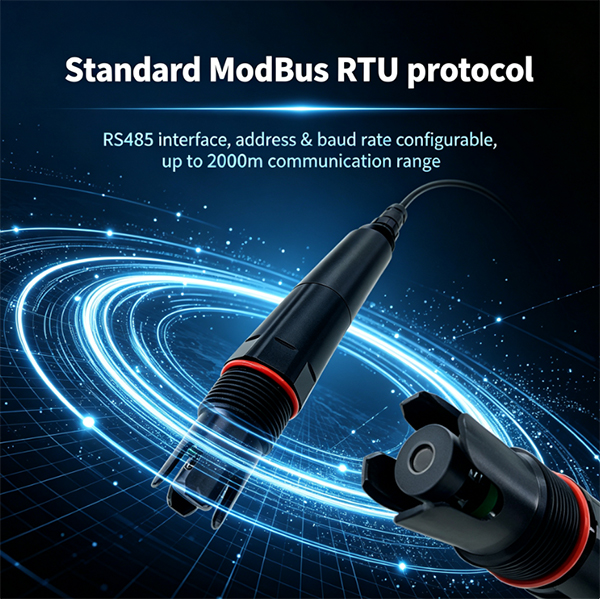
The RS485 communication protocol features long transmission distance and strong anti-interference performance, ideal for long-distance data transmission. Paired with the standard Modbus RTU protocol, it delivers excellent universality for seamless integration with PLCs, DCS, industrial control computers and other systems. Compared with traditional 4–20 mA analog signals, RS485 digital signals boast superior noise resistance and long-distance transmission capabilities. For projects requiring connection to central control systems or environmental supervision platforms, sensors equipped with standard RS485 interfaces are the top priority.
As sensors stay submerged in water for extended periods, ingress protection and anti-corrosion performance are critical. The sensor body shall reach IP68 rating to guarantee reliability under long-term submersible installation. POM or 316L stainless steel are recommended housing materials to withstand corrosive water bodies. Most sensors support a working temperature range of 0–50 °C or broader; built-in Pt1000 automatic temperature compensation eliminates measurement deviations caused by water temperature fluctuations.
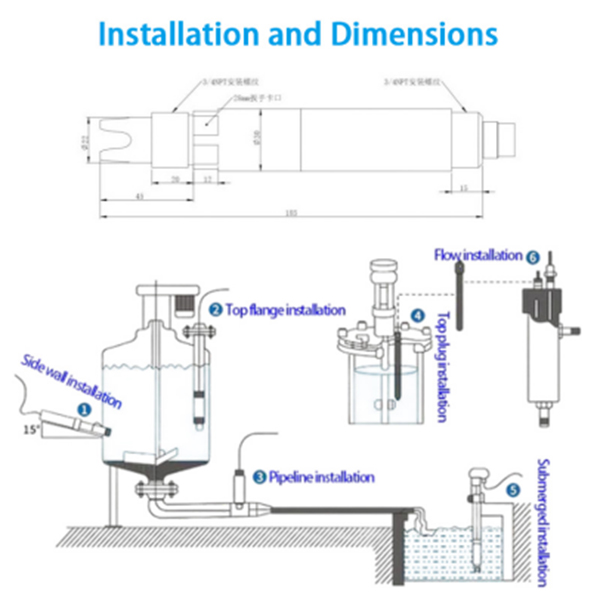
Two mainstream installation types are available: submersible and in-line pipe mounting. Submersible sensors adopt a 3/4" NPT thread for direct immersion in pools or open water bodies. Pipe-mounted variants are installed via bypass pipelines, suitable for circulating water systems. Match the installation style to your site layout, and avoid mounting positions with eddy currents or accumulated air bubbles.
Ion-selective electrode (ISE) chloride sensors generally adopt two-point calibration with standard buffer solutions for regular calibration. Electrodes have a service life of 6 to 12 months. When choosing sensors, confirm replaceable electrodes and stable spare parts supply. Models with self-diagnosis functions can monitor electrode status in real time and reduce unexpected breakdown risks.
The core principles for online chloride ion sensor selection are: matching working conditions, meeting accuracy standards, reliable ingress protection, and manageable maintenance. Prioritize mature sensors adopting Ion Selective Electrode (ISE) technology, with RS485 Modbus output, IP68 protection, wide measuring range and built-in automatic temperature compensation. If conditions permit, request sample units for on-site testing to guarantee accurate selection.

Tel : +86 18146178586
Whatsapp : +86 18146178586
E-Mail : qui@zonewu.com
Hinzufügen : 1501-3, Building F03, Phase III, Software Park, Jimei District, Xiamen City, Fujian Province, China